
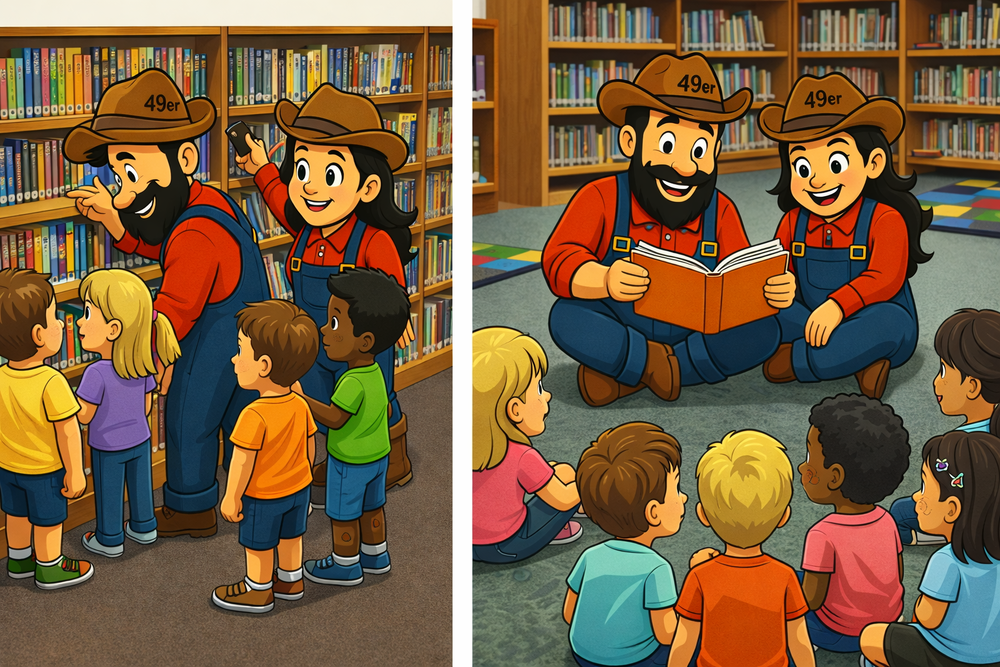
As Columbia Union School District continues to expand learning opportunities for students, one role stands out as essential to sustaining and strengthening our most important initiatives: a Library Media Specialist. Far from being a traditional, book-centered position, today’s Library Media Specialist serves as a hub for global education, technological literacy, and the district’s emerging work in digital and AI awareness. All of these are areas that are central to preparing Columbia students for the world they are inheriting.
Beginning in the 2026–27 school year, Columbia Elementary School’s Library Media Specialist will be fully credentialed and available to all grade levels, further strengthening our global education initiative, digital citizenship efforts, and the essential research and technology skills students need to fully engage in an increasingly connected and digital world.
Ms. Jessica Mathews, currently an English Language Arts and Social Studies Middle School Teacher, sees the library as “not a separate space, but an instructional partner that strengthens everything happening in the classroom.” She emphasizes that access to a credentialed teacher librarian ensures research, media literacy, and digital citizenship are embedded skills practiced consistently across grade levels and not afterthoughts.
Through collaboration with teachers, she curates high quality resources, pre-teaches research skills, builds students’ technology fluency, and supports learners who need additional guidance. Rather than teachers carrying research and technology instruction alone, they gain a specialist who provides expertise, planning support, and direct instruction, thereby strengthening learning while reducing workload.
Building on the Success of Global Education at Columbia
Columbia’s Global Education initiative has been one of the district’s most successful and transformative efforts. Through cultural exchanges, global partnerships, and internationally focused learning experiences, students have been exposed to perspectives far beyond our geographic boundaries. These experiences foster curiosity, empathy, communication skills, and an understanding that learning is not confined to a single classroom, town, or country.
“We look forward to taking the next step in our Global Education Initiative,” said Dr. Nicolas Wade, Superintendent. “The positive response from our students, staff, and families has led us to consider preparing a small group of students and staff to prepare to venture over to our friends in Taiwan.”
Dr. Wade did caution that it is in the early stages, but the district is working on developing a plan to prepare students and staff to engage professionally and responsibly in a new, culturally diverse environment, as well as procure some additional funding to assist with travel costs.
“When you have greater participation in the state’s Global Education Initiative than some larger metropolitan districts in Southern California, I think it becomes appropriate to consider elevating the experience for our students and staff who made this such a success to begin with,” explained Dr. Wade.
A Library Media Specialist is uniquely positioned to centralize and sustain this work. By curating global resources, coordinating digital collaborations with partner schools, supporting teachers in integrating global content into lessons, and providing students with access to diverse voices and viewpoints, the library becomes the physical and digital home of global learning. Rather than global education living in isolated projects or individual classrooms, it becomes woven into the daily academic experience for all students.
Teaching Digital Literacy Is No Longer Optional
In today’s world, access to information is no longer the primary challenge, but understanding, evaluating, and responsibly using it is. Digital literacy has become a foundational skill for citizenship, academic success, and workforce readiness. Students must learn how to determine the credibility of sources, recognize bias and misinformation, protect their digital identities, and engage respectfully in online spaces.
A Library Media Specialist serves as the district’s instructional leader in this area, partnering with teachers to provide explicit, developmentally appropriate instruction in research skills, media analysis, digital citizenship, and ethical information use from the earliest grades through middle school.
Ms. Mathews has observed firsthand how urgently this work is needed. “Within the past few years I’ve seen a significant shift in how students interact with information,” she explains. “Many students now approach information as something instant and unquestionable, and if it appears at the top of a Google search or in a social media post they often accept it as truth without examining the source, purpose, or credibility.”
She notes that today’s globally connected students are navigating more information than ever before and require explicit guidance to identify bias and misinformation. What can sometimes appear as apathy, she adds, is often a lack of skill and confidence. “When students don’t know how to search effectively and investigate sources for credibility, they disengage because the task feels overwhelming. The path of least resistance (accepting what they see without question) becomes a habit.”
Laying the Groundwork for AI Literacy
As artificial intelligence rapidly becomes part of everyday life, schools have a responsibility to move beyond fear or prohibition and toward thoughtful, ethical education. Columbia is actively building capacity around AI literacy so that students and staff understand what AI is, how it works, its limitations, and its ethical implications. A Library Media Specialist plays a central role in this effort. Positioned at the intersection of information literacy, technology, and instruction, the librarian helps students use AI tools responsibly, craft stronger questions, verify outputs, and recognize issues of bias, privacy, and authorship. Additionally, the position will also be supporting staff in developing shared expectations and instructional practices around AI use.
Ms. Mathews explains that, “AI literacy connects seamlessly to the information literacy and research skills taught in the library because at its core, AI is simply another way information is created, organized, and delivered.”
The same skills students use in traditional research, like asking strong questions, selecting strategic keywords, evaluating credibility and synthesizing information ethically, apply directly to AI.
“When students use AI tools, those exact same skills apply,” she notes. “They must craft effective prompts, analyze responses for accuracy and bias, verify claims with reliable sources, and determine whether the output truly answers their research question.” In her words, “AI does not replace research skills, it amplifies the need for them.”
Both Dr. Wade and Ms. Mathews also emphasize that avoiding AI is not a solution. Students are naturally curious about emerging technologies and will use them regardless. “Ignoring AI does not prevent its use, it simply leaves students unprepared to use it safely and ethically,” she explains.
Without guidance, students may rely on AI uncritically, submit work they do not fully understand, or accept inaccurate information without question. Structured, developmentally appropriate instruction ensures that AI becomes a tool for deeper learning rather than a shortcut that replaces thinking. In this way, AI literacy is not an add-on, but a natural evolution of the information literacy foundation the school library is uniquely positioned to provide.
“At Columbia, we really only dipped a couple toes in the water when it comes to AI,” elaborated Dr. Wade. “Our staff receive ongoing AI literacy training and have access to some meaningful tools, and the students have access to some literacy and math assistance that are supported by AI. While that is still considerably more exposure and use than a plurality of schools across the county, we are ready to level up.”
A Central Hub for Learning, Not Just a Space
At its core, the modern school library is not defined by shelves, but by its purpose. It is a collaborative learning environment, a launch point for inquiry, and a space where students learn how to navigate an increasingly complex world. A Library Media Specialist ensures that this space, and the learning that happens within it, is intentional and equitable.
Today’s school library is far more than a place for students to check out books, it is the academic and digital learning hub of the campus. In addition to fostering a love of reading, the library teaches students how to evaluate information, think critically about online content, conduct meaningful research, use technology responsibly, and develop global competence. In a world where children are constantly exposed to digital media and artificial intelligence, the library provides structured, developmentally appropriate guidance that helps them become thoughtful, informed learners. It also serves as a bridge between classrooms, families, and the broader community, nurturing curiosity, creativity, and lifelong learning. Investing in the library media center is ultimately an investment in the critical thinking, digital responsibility, and academic success of every child on campus.
For Columbia, investing in a Library Media Specialist is an investment in the sustainability of our global education success, the strength of our digital literacy instruction, and the responsible development of AI literacy. It is a commitment to preparing students not just for the next grade, but for lifelong learning in a global, digital, and AI-influenced society.
In short, a Library Media Specialist is not an “extra.” They are central to who we are becoming as a district and to the future we want for our students.